

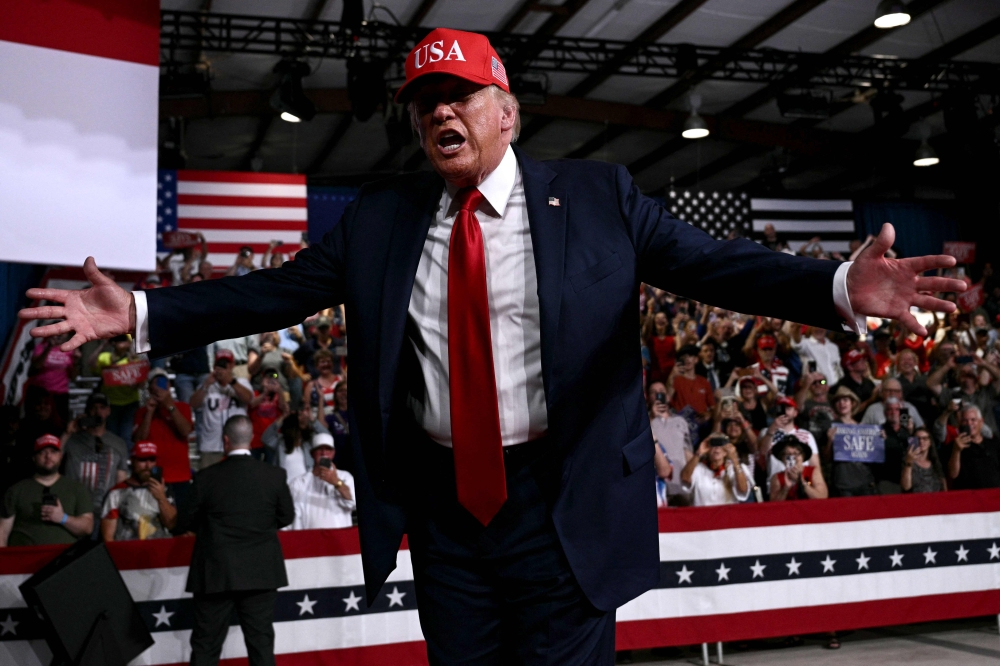
US President Donald Trump has warned that the European Union could face “very heavy tariffs” if Brussels moves forward with plans to deepen its relationship with Canada.
Trump made the remarks after European Commission President Ursula von der Leyen proposed that Canada could become the European Union’s first associate member. The proposal comes at a time when both Canada and the EU are seeking stronger partnerships amid growing trade tensions and geopolitical uncertainty involving the United States and China.
Speaking to reporters, Trump described the idea as “laughable” and said Washington could respond if the move were considered hostile. He warned that the United States could impose significant tariffs on European goods or even consider reducing trade with the bloc.
“If it’s a good intention, that’s fine. If it’s a bad intention, we’ll put very heavy tariffs on Europe,” Trump said.
Von der Leyen made her proposal during her annual “State of the European Union” address in Strasbourg, where Canadian Prime Minister Mark Carney was invited to attend. Carney was scheduled to address the European Parliament the following day, becoming the first non-European head of government to participate in the event.
Calling for a deeper partnership, von der Leyen argued that Canada and the European Union should strengthen cooperation in areas including technology, defence, energy and economic security.
“I would like to work with you on opening the door for Canada to be the first associate member of the EU,” she told Carney, receiving a standing ovation from members of the European Parliament.
Canada and EU look beyond traditional trade ties
Canada has been working to strengthen its relationships with European partners as tensions with the United States continue to affect its economic and diplomatic environment.
Von der Leyen said the EU-Canada relationship should evolve beyond traditional trade cooperation into what she described as an “alliance for the future.”
The areas discussed include artificial intelligence, critical minerals, batteries, cyber security, energy, intelligent manufacturing and defence industries. Cooperation in the Arctic was also highlighted as a potential area for closer collaboration.
“This is a partnership not against anyone else, but for our common strength,” von der Leyen said.
For Canada, the proposed relationship comes as the country seeks to diversify its international partnerships. Carney’s office said Canada was working to build stronger relationships with trusted partners in response to a more divided global environment.
What would associate EU membership mean?
The concept of “associate membership” is not currently defined as a standard membership category under EU treaties, leaving questions about what such an arrangement with Canada would actually involve.
A similar concept was previously discussed in relation to Ukraine. The proposed model included participation in certain EU meetings and access to selected programmes while stopping short of full membership and voting rights.
The precise meaning of the proposal for Canada therefore remains unclear.
German lawmaker Tobias Cremer, who has supported stronger EU-Canada cooperation, said after von der Leyen’s announcement that the details of what associate membership would mean still needed to be determined.
Any formal partnership involving the EU and a third country would also require agreement from the bloc’s member states, meaning the proposal would need to go through further political and institutional discussions.
Canada and EU already have strong economic links
The European Union and Canada already have an established trade relationship through the Comprehensive Economic and Trade Agreement, known as CETA.
The agreement removed almost all tariffs between the two sides and has been associated with significant growth in trade in goods and services since its provisional implementation in 2017.
Canada has also expanded its cooperation with the EU in defence. Earlier this year, it became the first non-EU country to participate in a major European defence loan programme.
The latest proposal could therefore represent an attempt to build on an existing relationship rather than create an entirely new partnership.
A changing global trade landscape
The dispute highlights how quickly international trade relationships are evolving. Canada is strengthening its connections with Europe, while the EU is seeking broader partnerships in technology, defence, energy and strategic industries.
At the same time, the possibility of new US tariffs adds another layer of uncertainty for businesses, governments and consumers on both sides of the Atlantic.
For Canada and Europe, the challenge now is turning political statements about closer cooperation into practical agreements. For the United States, Trump’s warning signals that Washington will closely watch how these new international partnerships develop.
Ultimately, the story is bigger than one proposed membership arrangement. It reflects a world where countries are reassessing old economic relationships and looking for new ways to protect trade, security and strategic interests. What happens next will depend on negotiations in Brussels, Ottawa and Washington — and on whether closer cooperation can move from speeches into concrete action.