
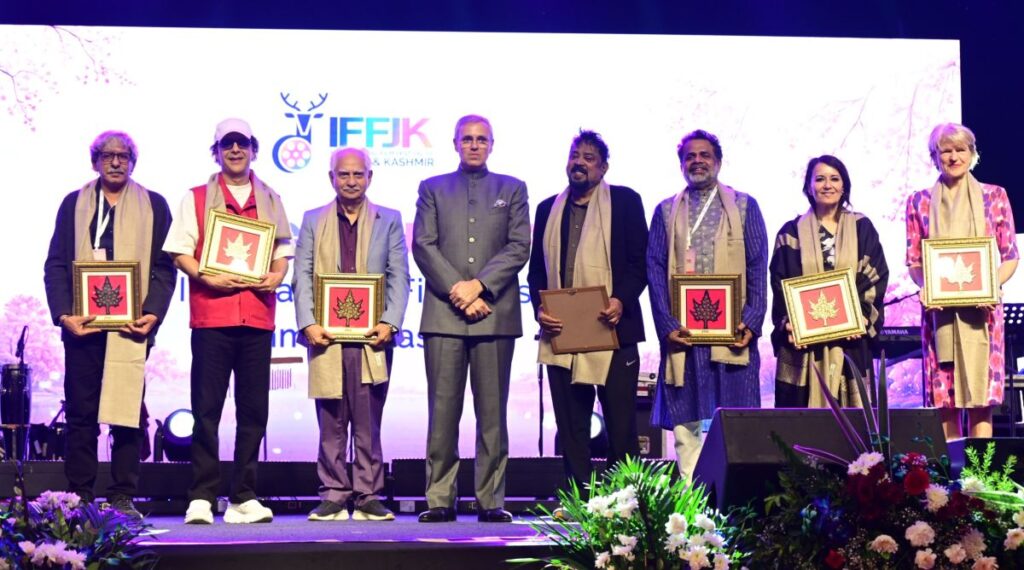
Filmmaker Vidhu Vinod Chopra believes the first International Film Festival of Jammu and Kashmir could become a major turning point for the region’s growing film culture, opening its doors to international cinema while giving local filmmakers a platform to tell their own stories to the world.
Speaking to reporters on Monday on the sidelines of the festival’s opening at the Sher-i-Kashmir International Convention Centre in Srinagar, Chopra expressed strong optimism about what the new festival could mean for Jammu and Kashmir.
“I hope so, in fact, I fully expect so. I am very optimistic,” Chopra said.
For the filmmaker behind acclaimed films such as Parinda, 12th Fail and Mission Kashmir, and the producer of popular franchises including Munnabhai and films such as 3 Idiots, the occasion carried a deeply personal meaning.
Chopra, who grew up in Kashmir, reflected on his own journey and said his story should give young people in the region reason to believe that their circumstances do not have to define their future.
“If I, a young Kashmiri boy from a humble background, can achieve what I have, any one can,” he said, adding that there is “massive hope” for everyone.
He also expressed his gratitude to the government for taking the initiative to establish the International Film Festival of Jammu and Kashmir.
“For me, this is truly a homecoming,” Chopra said.
A Platform for Kashmir’s Untold Stories
Beyond bringing international cinema to Kashmir, Chopra believes the festival could help take Kashmiri stories far beyond the Valley.
He pointed to the enormous creative potential among young people in the region and encouraged aspiring filmmakers not to wait for perfect circumstances before beginning their journey.
“There is so much talent in Kashmir, I see so much talent,” he said.
His message to young filmmakers was simple: pick up a camera, make a film and allow the world to see what they are capable of.
According to Chopra, the festival represents a rare opportunity for Kashmiri filmmakers and students to meet, interact and learn from established filmmakers and artists from different parts of the world.
He also drew a comparison with major international film festivals, noting that the location of a festival can become part of its identity.
“The Cannes Festival is so massive because it is in Cannes. This is in Kashmir, so it will feature Kashmir’s stories,” he said.
For Chopra, Kashmir has a wealth of stories that are unique to its people and cannot simply be recreated elsewhere.
“We have our own stories. This is a festival through which our stories will reach the world,” he added.
Fatima Sana Sheikh Calls Regional Cinema Important
Actor Fatima Sana Sheikh, who hosted the festival, also spoke about her personal connection with Kashmir. With her mother originally from the region, Sheikh said returning to Kashmir brought back memories from her childhood.
“Sometimes we forget what it feels like to come home,” she said, recalling how memories came rushing back the moment she arrived.
Sheikh welcomed the initiative and highlighted the importance of giving regional cinema greater visibility.
She pointed out that stories about Kashmir have often been presented through an outsider’s perspective. Regional cinema, she said, offers audiences something different by allowing them to experience a place through the eyes of people who actually belong to it.
“Regional cinema captures the local intricacies,” she said, emphasizing that people and communities should not be defined only by what they see in the news.
Her larger message was that Kashmir represents much more than the images and narratives audiences may encounter through headlines.
Music, cinema and poetry, she suggested, can help those deeper stories travel across borders and connect people in ways that conventional narratives often cannot.
Taha Shah Badussha Highlights Kashmir’s Natural Beauty
Actor Taha Shah Badussha, known for his appearance in Heeramandi, also hosted the opening event.
Speaking about the region, he highlighted Kashmir’s extraordinary natural beauty and said filmmakers visiting the Valley are likely to be deeply impressed by what they find.
The presence of filmmakers, actors and artists at the festival adds another dimension to the event, creating opportunities for cultural exchange and conversations between established names in cinema and emerging creative voices from the region.
IFFJK 2026 Brings World Cinema to Kashmir
Organised by the Directorate of Information and Public Relations of the Union Territory of Jammu and Kashmir, the International Film Festival of Jammu and Kashmir 2026 is being held from September 7 to 10.
The festival has been conceived as a platform focused on artistic excellence, cinematic innovation and cultural exchange, while encouraging audiences in the region to discover and engage with world cinema.
But perhaps its biggest promise lies beyond the screenings themselves.
For young filmmakers in Kashmir, the festival offers an opportunity to move from simply watching cinema to becoming part of the global filmmaking conversation.
Chopra’s message captures that possibility: Kashmir does not only have beautiful landscapes. It has people, memories, struggles, dreams and stories that deserve to be seen and heard.
The success of IFFJK may ultimately be measured not only by the films screened during these four days, but by what happens after the festival ends — how many young filmmakers pick up their cameras, how many local stories find their way onto screens, and how widely those stories travel.
For a region with such a rich cultural and artistic heritage, the arrival of an international film festival could be more than another event on the calendar. It could be the beginning of a new chapter for Kashmiri cinema.