

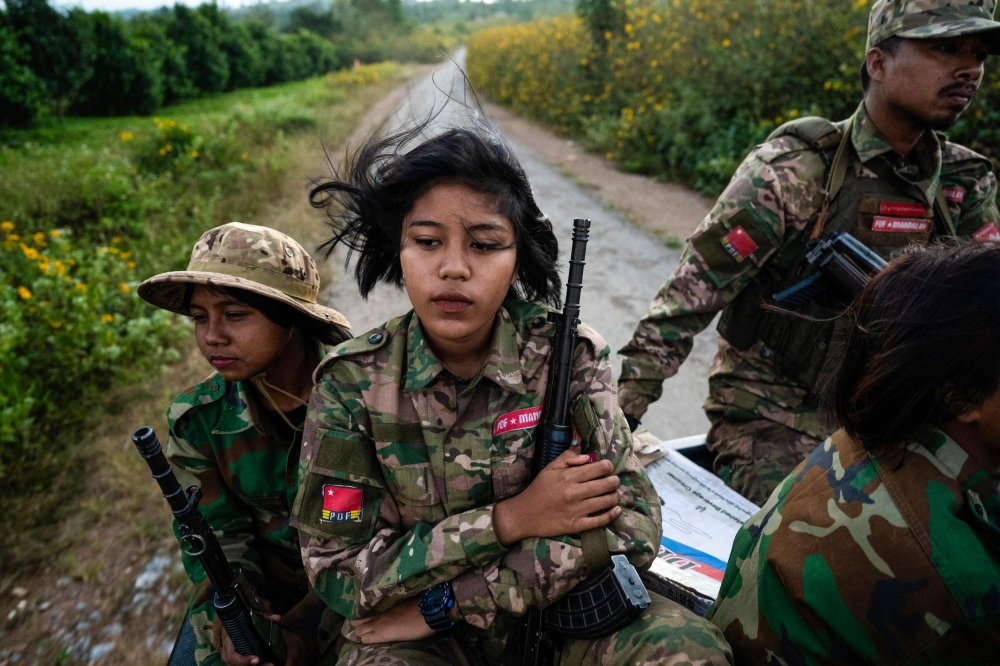
More than five years after Myanmar’s military seized power in a coup, the country continues to suffer an unimaginable humanitarian crisis. According to the latest figures from conflict monitoring organization Armed Conflict Location & Event Data (ACLED), over 100,000 people have lost their lives in conflict-related violence since February 2021.
The military takeover ended Myanmar’s brief democratic transition when the elected government led by Aung San Suu Kyi was removed from power. The Nobel Peace Prize winner was detained, and widespread public protests that followed were met with force, pushing many civilians to join armed resistance groups alongside ethnic organizations that have fought for autonomy for decades.
Although there is no official death toll, analysts consider Myanmar’s civil war to be the deadliest active conflict in Asia today.
For countless families, the numbers represent deeply personal tragedies.
Forty-nine-year-old Thein Aye Nu is one of many grieving relatives. Her husband was killed during an airstrike in Myanmar’s western Rakhine State last month.
“The pain never truly ends,” she said while reflecting on her loss.
Filled with sorrow and frustration, she explained that she no longer knows who deserves her anger. Instead, she tries to find peace by accepting what has happened as fate.
A Nation Living Through Constant Conflict
Since the coup, military leader Min Aung Hlaing ruled the country for five years before stepping into the role of civilian president following tightly controlled elections held earlier this year.
Critics dismissed the election as lacking credibility, arguing that major opposition parties were excluded and rebel-held territories did not participate. Armed resistance groups have also rejected calls for peace talks, saying they view them as attempts to improve the military government’s international image rather than genuine efforts toward reconciliation.
Across Myanmar, countless families continue to mourn loved ones lost to the conflict.
One father from Myanmar’s central Magway region shared the heartbreaking story of his teenage son, who left home to join pro-democracy fighters and was later killed in battle.
He recalled that heavy artillery shelling prevented the family from performing proper Buddhist funeral rites.
“My son left behind so many memories,” he said. “I wish we could have done more to honor him.”
Millions Forced From Their Homes
The humanitarian impact continues to grow.
According to the United Nations, more than 3.7 million people have been displaced inside Myanmar, while millions more face severe food shortages as poverty spreads across the country.
Violence varies from region to region.
In Yangon, Myanmar’s largest city, targeted killings still occur from time to time. Elsewhere, communities endure daily airstrikes and prolonged fighting involving military aircraft supplied by Russia and China.
ACLED ranked Myanmar as the world’s second most conflict-affected country last year, behind only the Palestinian territories.
Researchers have documented more than 1,200 separate armed groups involved in the conflict, describing Myanmar as the world’s most fragmented war.
According to ACLED senior analyst Sun Mon Thant, the fighting has expanded into nearly every part of the country, placing civilians at constant risk.
Shifting Battle Lines
The balance of power has changed several times throughout the conflict.
Beginning in late 2023, coordinated offensives by several resistance groups resulted in major territorial gains, bringing them close to Myanmar’s second-largest city, Mandalay. At one point, observers believed they might even capture the historic city.
However, analysts say recent developments have strengthened the military’s position after increased support from China and ceasefire agreements involving two influential ethnic armed groups.
Young People Caught in the War
In February 2024, Myanmar’s military enforced mandatory conscription in an effort to increase troop numbers.
The policy has drawn widespread criticism, with many young people reportedly forced into military service.
One former conscript who later deserted described the experience as hopeless.
He said many recruits receive little preparation before being sent directly to dangerous front-line positions.
“If you survive one battlefield,” he explained, “they simply send you to another.”
A Crisis Reaching Beyond Myanmar’s Borders
The conflict’s impact extends far beyond Myanmar itself.
Hundreds of thousands of refugees have crossed into neighboring Thailand and Bangladesh, seeking safety from violence.
At the same time, international monitors warn that prolonged instability has fueled organized crime, including the expansion of drug trafficking involving heroin and methamphetamine.
Myanmar’s remote border regions have also become notorious for online scam compounds, where criminal networks reportedly operate under the protection of armed groups.