

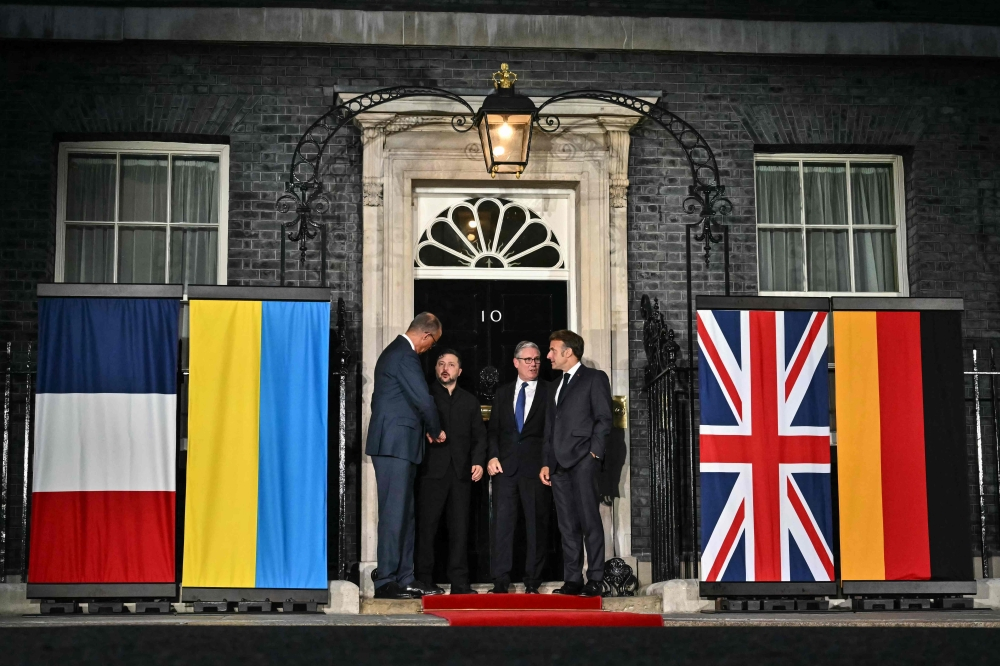
As the war in Ukraine continues to reshape Europe’s security landscape, Ukrainian President Volodymyr Zelensky traveled to the United Kingdom for a series of high-level defence discussions with key European allies following a new wave of Russian attacks that left multiple people dead and damaged a nuclear-related facility near Chernobyl.
Upon arrival in London, Zelensky was welcomed by British Prime Minister Keir Starmer at 10 Downing Street. The Ukrainian leader was also scheduled to meet French President Emmanuel Macron and German Chancellor Friedrich Merz, underscoring the growing importance of European cooperation amid ongoing security threats.
Ahead of the meetings, Zelensky emphasized that strengthening Ukraine’s defence capabilities remains a top priority. Discussions are expected to focus on expanding air defence cooperation, enhancing European security coordination, and ensuring that Europe maintains a meaningful role in future diplomatic negotiations regarding the conflict.
Ukraine has repeatedly appealed to its Western partners for additional military support, particularly ammunition and air defence systems, as Russian drone and missile attacks continue to target cities and critical infrastructure across the country.
One of the most alarming incidents occurred when a Russian strike reportedly hit a facility connected to nuclear waste storage within the Chernobyl exclusion zone. Ukrainian authorities stated that while radiation levels remained within safe limits, parts of the facility sustained damage. Ukraine’s nuclear energy operator confirmed that a fuel reception building suffered partial destruction during the attack.
The incident has raised fresh concerns among international observers, particularly because the site is linked to the storage of spent nuclear fuel from Ukraine’s active nuclear power plants. The International Atomic Energy Agency (IAEA) described the situation as deeply concerning and announced plans to send experts to assess the damage firsthand.
Meanwhile, hostilities continue to escalate on both sides. Ukrainian officials reported deadly Russian strikes in the Zaporizhzhia and Dnipropetrovsk regions, resulting in civilian casualties and further destruction. At the same time, Russian authorities accused Ukraine of launching drone attacks in the Belgorod region near the border, claiming civilian casualties there as well.
The conflict, now entering its fifth year since Russia’s full-scale invasion began in February 2022, has devastated communities across the region. Hundreds of thousands of lives have been lost or permanently altered, while millions have been displaced from their homes.
Efforts to secure a negotiated peace remain stalled. Diplomatic initiatives led by international partners have yet to produce a breakthrough, and direct talks between Kyiv and Moscow remain elusive. Despite these challenges, Ukraine continues to seek stronger international support while urging allies to maintain pressure on Russia.
The latest developments serve as another reminder that the war’s impact extends far beyond the battlefield. From humanitarian suffering to concerns about nuclear safety and regional stability, the consequences continue to affect not only Ukraine and Russia but the broader European continent and the international community.
As leaders gather to discuss defence, diplomacy, and security cooperation, the world watches closely to see whether renewed unity among Ukraine’s allies can help shape the next chapter of this prolonged conflict.