
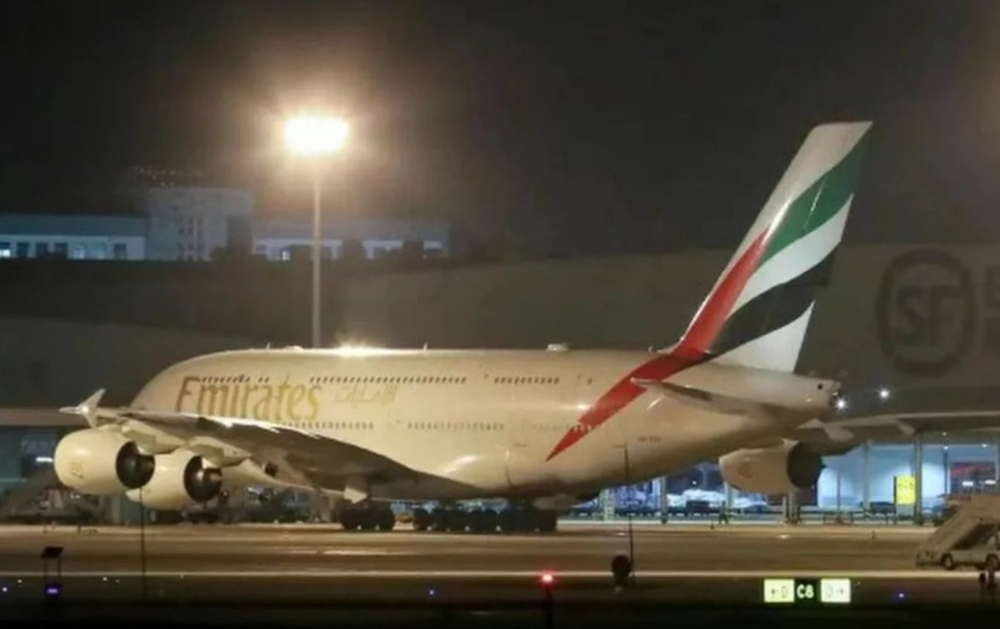
What began as a routine international journey from Dubai to Shanghai turned into an exhausting experience for hundreds of Emirates passengers after severe weather forced their Airbus A380 to divert to Hangzhou, China. Instead of reaching their destination on time, travelers found themselves trapped inside one of the world’s largest passenger aircraft for nearly 17 hours.
Emirates Flight EK302 had already spent around seven hours in the air and was preparing to land at Shanghai Pudong International Airport when intense thunderstorms made it unsafe for the aircraft to continue its approach. Prioritizing passenger safety, the flight crew diverted the aircraft to Hangzhou Xiaoshan International Airport.
While diversions due to bad weather are not uncommon in aviation, what followed proved to be far more challenging than anyone expected. The initial plan was to wait for the storm to pass before continuing to Shanghai. Since the diversion was considered temporary, immigration procedures for passengers were not immediately activated.
As the delay stretched on, another complication emerged. The operating crew eventually reached their maximum legally permitted duty hours, meaning they could no longer continue flying under international aviation safety regulations. Emirates arranged for a replacement crew to travel from Shanghai to Hangzhou, but heavy rain slowed their journey and added several more hours to the delay.
Passengers remained onboard throughout the night. According to multiple passenger accounts, the aircraft’s air-conditioning system temporarily lost power, making the cabin increasingly uncomfortable. Some travelers reportedly experienced health issues during the prolonged wait, prompting emergency personnel to respond.
The replacement crew eventually arrived in the early hours of the morning and restarted the aircraft’s systems. However, further technical inspections uncovered additional issues that prevented the Airbus A380 from safely departing.
After spending approximately 17 hours inside the aircraft—far longer than the original flight itself—passengers were finally allowed to disembark. Emirates later arranged hotel accommodation and transportation to help travelers continue their journey to Shanghai.
The aircraft remained grounded in Hangzhou for two days before eventually returning to Dubai.
In a statement following the incident, Emirates apologized for the disruption and explained that the unusually long delay resulted from a combination of severe weather, mandatory crew duty regulations, and technical issues discovered after the replacement crew arrived.
The airline also defended its decision to keep passengers onboard during the diversion, explaining that international flights redirected to alternate airports often remain on the aircraft to avoid complex immigration procedures, customs processing, and additional operational complications.
The incident has also sparked questions about airport coordination and passenger communication during unexpected disruptions. Some travelers criticized the lack of timely updates while waiting onboard, highlighting the importance of clear communication during extended delays.
The event serves as a reminder that modern aviation relies on a delicate balance of weather conditions, strict safety regulations, technical reliability, and operational logistics. When several of these challenges occur simultaneously, even one of the world’s most advanced airlines can face significant disruption. Despite the inconvenience, aviation experts continue to emphasize that safety decisions—especially during severe weather—remain the highest priority.