

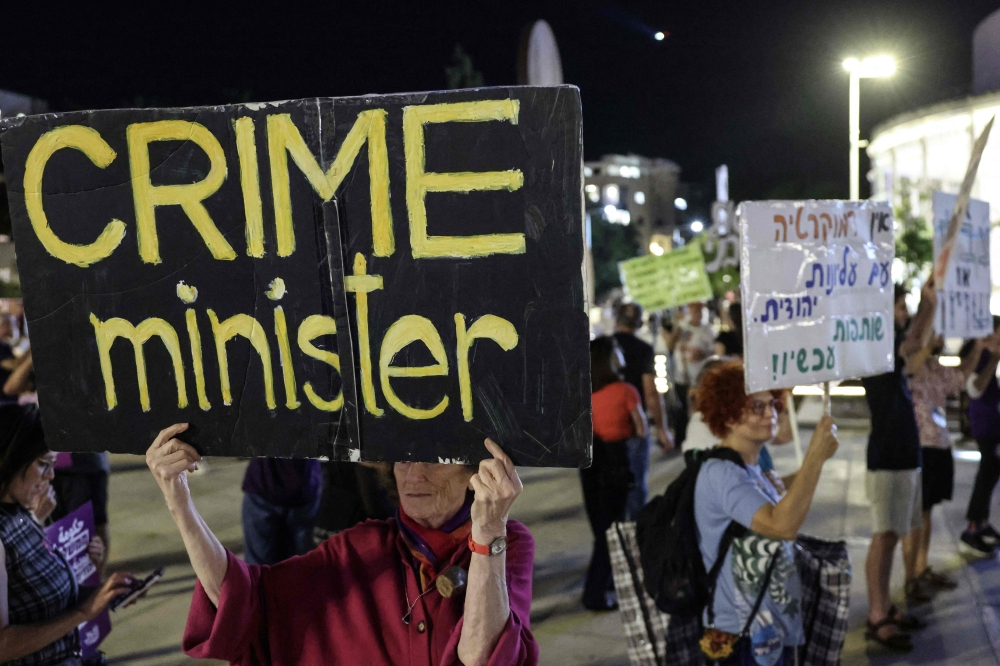
Hundreds of Israelis have taken to the streets, calling on opposition leaders to work alongside Arab political parties to form a government capable of ending Prime Minister Benjamin Netanyahu’s long-standing rule. The demonstrations reflect growing public divisions over the country’s political future and renewed demands for cooperation between Jewish and Arab communities.
The rallies took place in Tel Aviv and Jerusalem following an inconclusive election on Tuesday, in which neither political bloc secured enough seats to form a parliamentary majority. Protesters urged opposition leader Gadi Eisenkot to consider working with Arab-majority parties, arguing that political cooperation could create a genuine opportunity for change.
Ayelet Raz, a 60-year-old psychologist who joined the demonstration in Tel Aviv, said Arab citizens, who represent approximately 20 per cent of Israel’s population, deserve equal opportunities to participate in the country’s political system.
Describing the moment as a critical opportunity, she said Israel needed a different political direction and urged leaders to give peace a chance rather than allow the cycle of violence and confrontation to continue.
The election results have created an unusual political situation. Parties opposing Netanyahu secured 48 seats, while two Arab-majority political groups, Raam and the Joint List, won a combined 19 seats in Israel’s 120-member parliament.
Together, these parties could potentially command 67 seats, giving the opposition a parliamentary majority if they agree to cooperate. However, disagreements within the opposition have made such an arrangement far from certain.
Around 500 demonstrators gathered in Tel Aviv, holding signs promoting unity between Jewish and Arab communities. Messages such as “Arabs and Jews will only win together” and “There is a majority for change” reflected their demand for a more inclusive political approach.
In Jerusalem, another group of approximately 100 protesters carried placards calling for political unity, arguing that divisions within the opposition could ultimately benefit Netanyahu.
Arab parties have historically had limited involvement in Israeli governments. One notable exception occurred between 2021 and 2022, when Raam leader Mansour Abbas became part of a coalition government that eventually collapsed.
Abbas has indicated that he remains open to participating in another government arrangement. Meanwhile, Joint List politician Yousef Jabareen has expressed willingness to support Eisenkot in parliament without formally joining his government, pointing to concerns including the ongoing war in Gaza.
Opposition faces a difficult political decision
Despite calls for cooperation, the opposition remains divided over whether working with Arab political parties is the right strategy.
Eisenkot, a 66-year-old former military chief who has emerged as a significant political figure, maintains positions similar to Netanyahu on several national security issues, particularly concerning Gaza.
He has stated that he wants to establish a Zionist government committed to recognising Israel as a Jewish, democratic and liberal state, as well as recognising Hamas as a terrorist organisation. These conditions have previously been rejected by Arab political leaders.
Although Eisenkot has expressed reservations about forming a government dependent on Arab parties, he has not completely ruled out receiving their support from outside the coalition.
Demonstrators believe the opposition must be willing to take political risks if it genuinely wants to bring about change.
In Jerusalem, 55-year-old video artist Sharon Balaban urged opposition politicians to act courageously and make decisions that could open the door to a different political future.
Yair Golan, leader of the left-wing Democrats party, has openly supported the possibility of forming a government backed by Arab parties. He argues that excluding Arab representatives from political cooperation simply because of their identity would amount to discrimination. Golan also met with Mansour Abbas on Thursday.
However, not everyone within the opposition shares this position.
Avigdor Liberman, leader of the right-wing Yisrael Beiteinu party, has firmly rejected joining a coalition that depends on Arab parties, even if their support comes from outside the government.
His position highlights the difficult negotiations facing opposition leaders as they attempt to find common ground despite significant ideological differences.
Netanyahu supporters reject cooperation with Arab parties
While protesters in Tel Aviv called for Jewish-Arab political cooperation, Netanyahu supporters organised a counter-demonstration, highlighting the deep divisions within Israeli society.
More than 100 people gathered on the sidelines of the Tel Aviv rally, expressing opposition to any government arrangement involving Arab political parties.
Some participants repeated Netanyahu’s campaign slogan, presenting the political choice as a conflict between the Israeli right and Palestine.
Rebecca Schindler, a 60-year-old Netanyahu supporter, accused the two Arab parties of supporting Hamas and claimed their political involvement could threaten Israel’s national identity.
Another demonstrator, 70-year-old Nava Rehavia, called on Eisenkot and Liberman to join a Netanyahu-led government. She also questioned the election results, alleging that Arab parties had benefited from electoral misconduct.
Netanyahu himself raised allegations of irregularities during election day, claiming that Arab political parties had been involved in suspicious activities involving cash envelopes.
Police confirmed the arrest of three suspects, although the election commission described the reported incident as an isolated local case rather than evidence of widespread electoral fraud.
The prime minister subsequently raised further allegations concerning Arab politicians and alleged improper financial support from Qatar.
Netanyahu also used social media to criticise the possibility of cooperation between opposition parties and Arab political groups, describing such an arrangement as a disaster for Israel.
What happens next?
The next stage of political negotiations will be crucial for determining Israel’s leadership.
President Isaac Herzog is expected to give a political leader a mandate to form a government within 28 days, with the possibility of an additional 14-day extension.
Opposition leaders must now decide whether they can overcome their differences and build a coalition capable of securing a parliamentary majority.
The political uncertainty is unfolding alongside growing regional tensions. Netanyahu and US President Donald Trump have both hinted at the possibility of renewed military action against Iran, adding another layer of uncertainty to Israel’s domestic political situation.
For many Israelis participating in the demonstrations, however, the immediate concern goes beyond parliamentary numbers and political alliances. Their demands reflect a wider debate about representation, equality, coexistence and the direction of the country.
Whether Jewish and Arab political leaders can find enough common ground to form a government remains uncertain. What is clear is that the election has brought longstanding divisions into sharper focus and placed the question of political cooperation at the centre of Israel’s future.
The coming weeks will reveal whether the calls for unity translate into meaningful political action or whether disagreements within the opposition allow the existing political deadlock to continue.


