

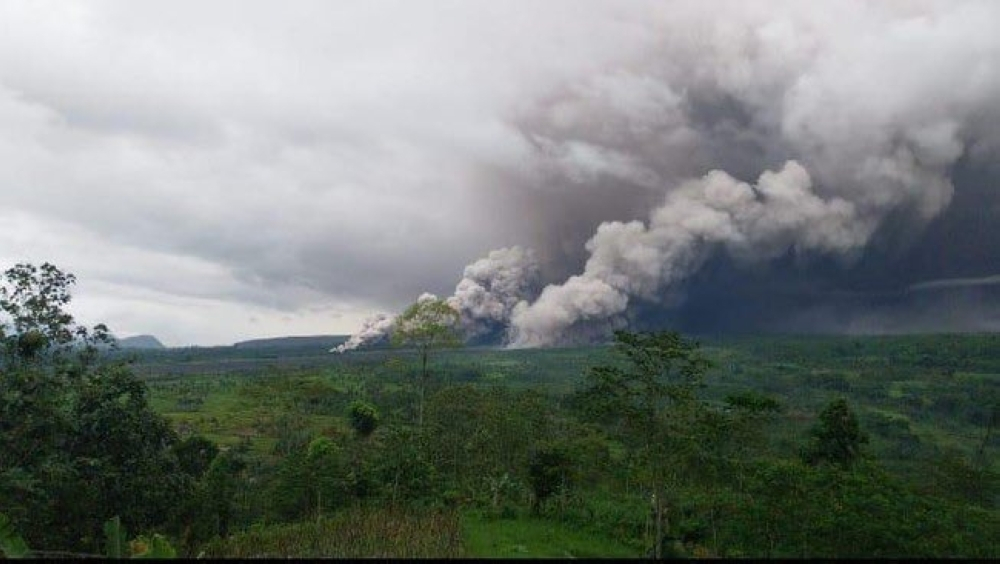
Indonesia’s Mount Semeru, one of the country’s most active volcanoes, erupted at least 10 times over a 13-hour period on Tuesday, sending volcanic ash hundreds of metres into the air and prompting renewed warnings about dangerous volcanic flows in East Java.
According to Indonesia’s Volcanology and Geological Hazard Mitigation Centre (PVMBG), the eruptions occurred between 12.09am and 1.11pm local time. Ash clouds were observed drifting towards the southwest and west, raising concerns about the potential impact on communities and areas surrounding the volcano.
The most significant ash columns were recorded during eruptions at 5.20am and 6.47am, when volcanic material rose approximately 900 metres above the summit, reaching an altitude of 4,576 metres above sea level.
Authorities have maintained Mount Semeru at Level III, the second-highest category on Indonesia’s four-level volcanic alert system. The continued alert reflects the potential dangers associated with volcanic activity, particularly pyroclastic flows, hot volcanic debris and volcanic mudflows that can move rapidly through river channels.
PVMBG has urged the public to stay away from areas considered particularly hazardous. People have been advised to avoid all activities within 13 kilometres of the summit along the Besuk Kobokan River in the volcano’s southeastern sector, where dangerous pyroclastic flows and volcanic mudflows may occur.
Authorities have also warned people to remain at least five kilometres away from the crater or summit because of the risk of incandescent rocks being ejected during eruptions. Such material can cause serious injuries and poses a significant threat to anyone approaching restricted areas.
The latest activity followed a series of eruptions earlier in the day. Between 12.09am and 5.13am, the volcano erupted five times, producing ash columns between 300 and 800 metres above its summit. Two further eruptions, recorded at 8.10am and 10.37am, sent ash approximately 800 metres into the air.
The most recent eruption included in the report occurred at 1.11pm, producing an ash column around 600 metres above the summit. Monitoring instruments recorded a maximum seismic amplitude of 15 millimetres, with the eruption lasting approximately 88 seconds.
Mount Semeru is situated along the boundary between Lumajang and Malang regencies in East Java. Its recurring eruptions make continuous monitoring and public awareness essential for communities living near the volcano, particularly those situated along river channels that could carry hot volcanic material and debris downstream.
Volcanic ash can also affect visibility, transportation, air quality and daily activities, depending on the direction and extent of the ash cloud. Residents in affected areas are therefore encouraged to follow official instructions, monitor updates from Indonesian authorities and avoid entering restricted zones.
The repeated eruptions serve as a reminder that volcanic hazards can extend beyond the crater itself. Pyroclastic flows can travel at extremely high speeds and temperatures, while volcanic mudflows can carry water, ash, rocks and debris into surrounding valleys and river systems.
For people living near Mount Semeru, staying informed and respecting evacuation advice and safety boundaries can make a critical difference. While volcanic activity cannot be prevented, timely warnings, careful monitoring and public cooperation remain essential to reducing the risk to lives and property.
Source: Bernama, citing Indonesia’s Volcanology and Geological Hazard Mitigation Centre (PVMBG).