

In a strong and direct statement, Hamas has declared that any serious discussion about the future of Gaza cannot move forward unless Israeli “aggression” comes to a complete stop.
The Palestinian Islamist movement made this clear shortly after US President Donald Trump’s newly formed Board of Peace held its first meeting in Washington. According to Hamas, political arrangements or reconstruction plans will not be meaningful unless they are rooted in what they describe as fundamental rights and immediate relief for the Palestinian people.
In its statement released Thursday, Hamas emphasized that the starting point for any political process must include:
- A total halt to military actions in Gaza
- The lifting of the blockade
- Guarantees of what it calls the Palestinian people’s legitimate national rights, including freedom and self-determination
The group made it clear that without these conditions, conversations about rebuilding or governing Gaza would lack credibility in their view.
Meanwhile, in Washington, Trump’s Board of Peace convened for the first time, marking a new diplomatic effort aimed at stabilizing and rebuilding Gaza. The meeting comes more than four months into a fragile ceasefire between Israel and Hamas — a ceasefire that continues to hold, but remains delicate.
During the session, several countries pledged financial support and personnel to assist with rebuilding efforts in Gaza. According to Trump, more than seven billion dollars has already been committed, largely from Gulf nations, signaling significant international interest in reconstruction.
However, Israel has drawn a firm line.
Israeli Prime Minister Benjamin Netanyahu stated that reconstruction cannot begin unless Gaza is demilitarised. Speaking after discussions with US officials, Netanyahu stressed that both Israel and the United States agreed there would be no rebuilding process without disarmament.
“We agreed with our ally the US that there will be no reconstruction of Gaza before the demilitarisation of Gaza,” he said.
Although Netanyahu did not personally attend the Washington meeting, Israel was represented by Foreign Minister Gideon Saar.
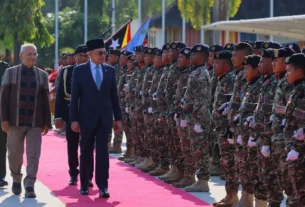
On the international front, plans are also underway to form an International Stabilisation Force to support post-conflict efforts. Major General Jasper Jeffers, the American commander of the initiative, confirmed that Indonesia will take on a deputy commander role. In addition, five countries — including Morocco, Kazakhstan, Kosovo, and Albania — have committed to contributing troops.
Trump’s broader Gaza proposal had previously received endorsement from the UN Security Council in November, adding further diplomatic weight to the reconstruction framework.
Yet, despite pledges of funding and military support, the central dispute remains unresolved: Hamas insists reconstruction must follow an end to what it calls Israeli aggression and a lifting of restrictions, while Israel maintains that disarmament must come first.
Between these opposing conditions lies the uncertain future of Gaza — a region that has endured months of devastation and whose people continue to wait for stability, security, and hope.
Behind every political demand, diplomatic meeting, and financial pledge are families who have lost homes, children who have missed school, and communities trying to survive in uncertainty. Beyond policy statements and international negotiations, the human reality in Gaza remains urgent and deeply personal.
The coming weeks will likely determine whether global commitments can bridge political divides — or whether the cycle of tension will once again overshadow efforts toward recovery.