

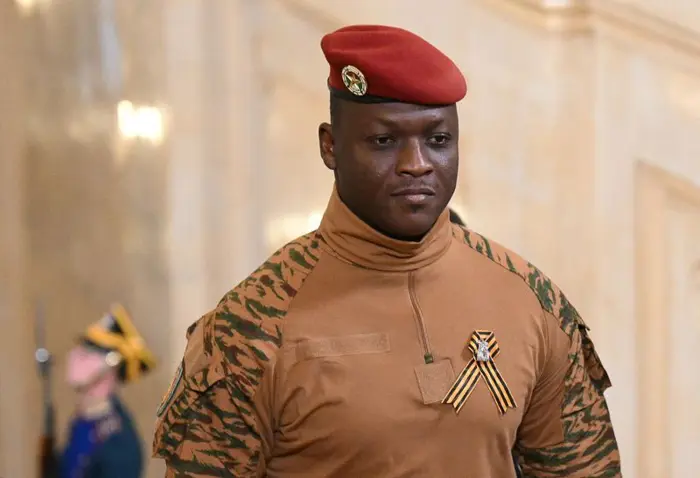
Burkina Faso’s military leader, Ibrahim Traore, has stirred global attention after openly questioning the role of democracy in the country’s future, suggesting it may not be suitable during a time of deep national crisis.
Traore, who took control following the Burkina Faso coup September 2022, stated during a televised discussion with journalists that citizens should “move past” the idea of democracy. According to him, the current priority is not political reform but national survival.
Originally, the military government had pledged to hold elections in 2024. However, Traore has since reversed that position, emphasizing that elections cannot take place until the country is stable and secure enough for citizens to safely participate.
Burkina Faso has spent more than a decade battling extremist violence linked to groups associated with al-Qaeda and Islamic State. These insurgencies have caused widespread devastation, resulting in thousands of deaths and forcing millions from their homes.
During the interview, Traore referenced the situation in Libya as an example of how externally imposed democratic systems can fail in fragile states. He argued that imposing such systems without stability can lead to further chaos rather than progress.
In a significant political move earlier this year, the government dissolved all political parties, effectively shutting down the democratic framework that previously existed. Prior to the coup, Burkina Faso had over 100 registered parties, with multiple groups represented in parliament following the 2020 elections.
The situation mirrors developments in neighboring Mali and Niger, where military governments have also dismantled political systems after seizing power.
Adding to the concern, Human Rights Watch recently released a report alleging that Burkina Faso’s military and allied forces have been responsible for significantly more civilian deaths than extremist groups since 2023. The government has not yet responded to these allegations.