

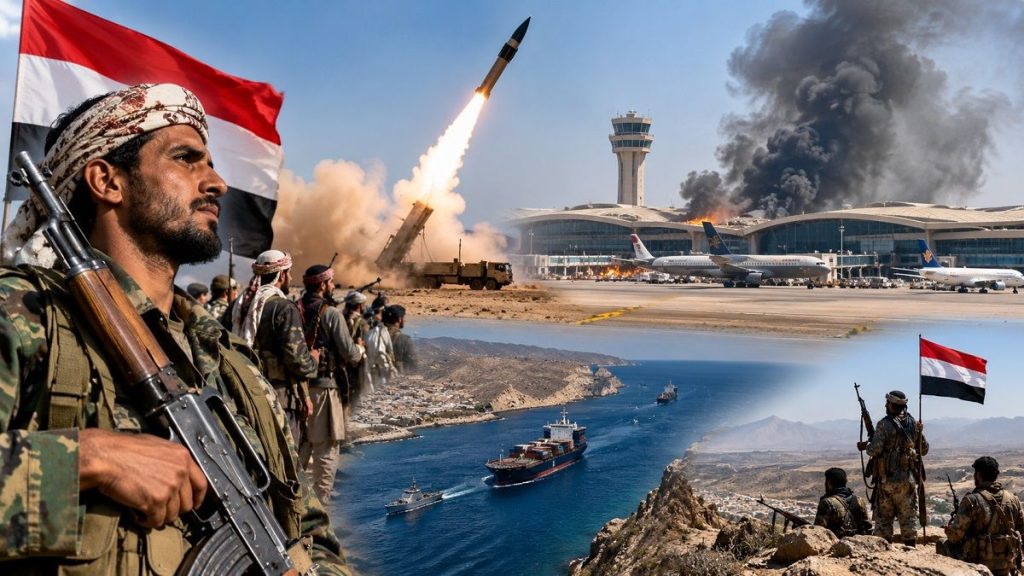
Yemen’s Houthi movement, also known as Ansarallah, is demonstrating an increasingly sophisticated military capability, raising fresh concerns about Saudi Arabia’s security, regional stability and the safety of vital international shipping routes. The Iran-aligned group, which controls large parts of Yemen, has reportedly intensified attacks on strategic Saudi targets while expanding its influence near important maritime corridors.
The developments highlight a growing challenge for Saudi Arabia and its regional partners. Despite years of military operations and airstrikes involving Saudi Arabia, the United Arab Emirates, the United States, Britain and Israel, the Houthis have continued to develop their military capabilities. Their resilience has raised difficult questions about the effectiveness of air campaigns against an armed movement operating across Yemen’s rugged and mountainous terrain.
According to reporting by The Associated Press, Saudi officials have accused Iran of encouraging the latest escalation, while diplomatic efforts to negotiate with the Houthis have faced significant obstacles. The situation reflects a wider regional struggle in which military pressure, political disagreements and competing security interests continue to complicate efforts to achieve a lasting settlement.
The Houthis’ expanding military capabilities
The Houthis possess a diverse arsenal that reportedly includes ballistic missiles, cruise missiles, unmanned aerial vehicles and anti-ship weapons. These capabilities allow the movement to threaten targets across the Gulf region and Israel, as well as commercial vessels travelling through the Red Sea.
Their use of relatively inexpensive drones and missiles presents a particular challenge for countries that rely on costly air-defence interceptors. Even when sophisticated defence systems successfully intercept incoming weapons, repeated attacks can place considerable pressure on military stockpiles and increase the financial cost of protecting critical infrastructure.
The movement also benefits from Yemen’s geography. Mountainous terrain, remote areas and dispersed military infrastructure can make it difficult for opposing forces to identify and eliminate weapons facilities. At the same time, Saudi Arabia’s extensive territory and long border with Yemen leave numerous locations requiring protection.
Reports by United Nations experts have documented military connections between the Houthis and Iran, alongside other regional actors. Weapons components and suspected Iranian-linked shipments have also been seized in previous maritime operations. Iran denies supplying weapons to Yemen in violation of international restrictions, while China has not directly addressed the latest allegations concerning components reportedly sourced from Chinese suppliers.
A recent report cited in the coverage suggested that the Houthis had explored obtaining components that could support the production of precision-guided ballistic missiles with a reported range of approximately 2,000 kilometres. Such developments, if confirmed, could further complicate regional defence planning.
The movement’s manpower has also reportedly expanded considerably. A 2024 assessment by United Nations experts estimated that the Houthis had recruited as many as 350,000 fighters, compared with approximately 30,000 in 2015. These figures illustrate the scale of the challenge facing those seeking to weaken the group through military pressure alone.
Saudi Arabia faces growing pressure
Saudi Arabia possesses advanced military aircraft, American-supplied weapons and sophisticated air-defence systems. However, defending a large country against repeated missile and drone attacks is a complex undertaking, particularly when threats can emerge from multiple directions and target infrastructure spread across vast distances.
Recent attacks described in the report have included strikes targeting King Khalid International Airport in Riyadh and facilities associated with Saudi Aramco, the kingdom’s national oil company. The reported disruptions, including flight cancellations, have highlighted the potential economic consequences of attacks on transport and energy infrastructure.
The human and social costs are also significant. The report cited at least 19 deaths and the cancellation of school classes amid the wider disruption. Further escalation could affect public confidence, business activity and the movement of people and goods.
Saudi Arabia has invested heavily in plans to diversify its economy and establish itself as a major destination for international business, tourism, entertainment and sports. Continued insecurity threatens to complicate those ambitions by increasing operational risks, raising security costs and potentially discouraging investment.
The kingdom’s energy infrastructure is particularly important because disruptions can have consequences far beyond its borders. Any sustained threat to oil production, export facilities or critical pipelines could affect global energy markets and international supply chains.
Why years of airstrikes have failed to end the conflict
The current confrontation has its roots in Yemen’s prolonged civil war. Saudi Arabia intervened in 2015 after the Houthis captured large parts of the country, including the capital, Sanaa. Riyadh feared that the emergence of a powerful Iran-aligned movement along its southern border would create a lasting security threat.
Years of airstrikes and military operations caused extensive damage in Yemen, with civilians among those killed. However, forces backed by Saudi Arabia and other regional partners struggled to dislodge the Houthis from their strongholds. The conflict eventually reached a period of reduced hostilities following a ceasefire in 2022, although a comprehensive political settlement remained elusive.
Regional tensions intensified again after the outbreak of the Gaza war in October 2023. The Houthis began attacking commercial shipping in the Red Sea, saying their actions were linked to the conflict involving Israel and the Palestinians. The United States and Britain responded with military strikes against Houthi targets beginning in January 2024.
Subsequent American military operations and Israeli strikes also targeted the movement. Despite the destruction inflicted on various facilities, the Houthis retained significant operational capabilities. The group’s ability to continue launching attacks has reinforced concerns that airpower alone may not be sufficient to eliminate a deeply established armed movement.
The latest escalation, as described in the report, indicates that the confrontation is not limited to the Red Sea. Threats to Saudi territory and shipping could widen the conflict, increasing the risk of further retaliation and drawing additional regional actors into the crisis.
The difficulties of defeating the Houthis on the ground
Military analysts have long noted that airstrikes may damage weapons facilities and infrastructure without necessarily removing an armed group’s control over territory. A sustained campaign to defeat the Houthis could require effective ground forces capable of holding territory, disrupting supply networks and establishing a viable alternative to their administration.
However, anti-Houthi groups in Yemen remain divided. They include forces aligned with the internationally recognised government and southern separatists supported by the United Arab Emirates. These groups have different political objectives and have previously fought one another, weakening their ability to operate as a unified force.
Saudi Arabia and the UAE have also had competing interests in Yemen, adding another layer of complexity to efforts to coordinate a common strategy. Without greater political and military unity among opponents of the Houthis, any attempt to change the balance of power on the ground could prove difficult.
The United States also faces competing priorities, particularly its broader confrontation with Iran. Meanwhile, Saudi Arabia has strengthened its regional security relationships, including through a reported mutual defence agreement with Pakistan and closer engagement with Turkey. The extent to which these partnerships would translate into direct military assistance in a wider conflict remains uncertain.
Diplomacy presents its own challenges. The Houthis have demanded changes to restrictions affecting Yemen, including the blockade, while Saudi Arabia seeks to protect its territory, economic interests and regional position. Reaching an agreement that addresses these competing demands without encouraging further escalation will require difficult negotiations.
What the escalation means for regional and global security
The growing military reach of the Houthis has implications beyond Saudi Arabia and Yemen. The Red Sea is a critical route for international trade, connecting markets through the Suez Canal and linking Europe, Asia and the Middle East. Attacks on commercial vessels can force shipping companies to change routes, increase insurance costs and delay deliveries.
For energy markets, continued threats to Saudi infrastructure could introduce further uncertainty. For neighbouring countries, the prospect of missile and drone attacks creates pressure to strengthen air defences and reassess national security strategies.
The situation also demonstrates how relatively inexpensive weapons can challenge much more powerful militaries. Drones and missiles do not need to destroy every target to have an economic or strategic effect. Repeated disruptions, the cost of interception and uncertainty surrounding future attacks can place sustained pressure on governments and businesses.
Nevertheless, the scale of the Houthis’ capabilities should not obscure the wider humanitarian crisis in Yemen. Years of conflict have left communities facing severe hardship, damaged infrastructure and limited access to essential services. Further military escalation risks deepening those problems while making political reconciliation even more difficult.
A lasting solution requires more than military force
The latest developments reveal a difficult reality for Saudi Arabia and its partners: advanced weapons and repeated airstrikes have not eliminated the Houthi movement or removed the threat it poses to regional security. At the same time, a broader ground offensive could carry enormous military, political and humanitarian costs.
A sustainable outcome will likely depend on a combination of credible security arrangements, coordinated regional diplomacy, reduced external support for armed confrontation and a political process that addresses Yemen’s internal divisions. Protecting shipping lanes and civilian infrastructure will also remain essential to preventing the conflict from spreading further.
Behind every missile launch, airstrike and security alert are ordinary people whose lives depend on stability. Families need safe communities, workers need reliable livelihoods and businesses need confidence that goods and services can move without constant disruption.
The real measure of success will not simply be which side possesses the most powerful weapons. It will be whether regional leaders can prevent further loss of life, protect essential trade routes and create conditions in which Yemen and its neighbours can move away from years of conflict towards lasting peace.
Source attribution: Based on reporting by The Associated Press (AP).