

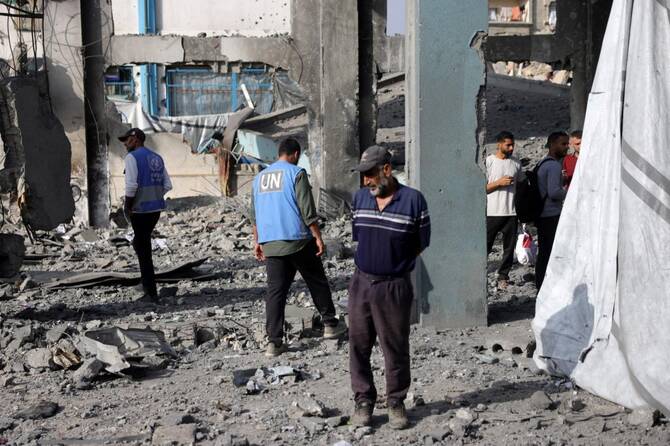
Humanitarian workers faced an increasingly dangerous world in 2025, with attacks against people delivering lifesaving assistance reaching a record level, according to figures cited by the United Nations.
A total of 907 aid workers were killed, injured or kidnapped during 2025, up from 833 in 2024, according to the Aid Worker Security Database, which tracks major security incidents involving humanitarian personnel. Of those affected, 350 aid workers were killed. Although that figure was slightly lower than the record 387 deaths reported in 2024, the overall number of serious incidents continued to rise.
UN Secretary-General Antonio Guterres described the situation as “appalling” and called on governments and armed groups to respect international humanitarian law and ensure that those responsible for attacks are held accountable.
The growing danger is changing what it means to deliver humanitarian assistance. Aid workers are increasingly operating in environments where even routine movements, convoys and distributions can become life-threatening.
“Serving others has become more dangerous than ever,” Guterres said ahead of World Humanitarian Day events honoring humanitarian workers who lost their lives while helping others.
One of the emerging threats is the growing use of armed drones. UN aid chief Tom Fletcher said the availability of relatively inexpensive and adaptable drones has increased risks for humanitarian teams working in conflict zones.
Recent incidents demonstrate the scale of the danger. In March, drone strikes in Goma, in the eastern Democratic Republic of Congo, killed at least three people, including a French aid worker. Humanitarian convoys in Sudan and Ukraine have also repeatedly come under attack.
Gaza remained the deadliest location for aid workers in 2025. According to the database, 186 humanitarian workers were killed there during the year.
The wider toll on humanitarian personnel in Gaza has also been devastating. The UN Palestinian refugee agency, UNRWA, has reported that at least 393 of its staff members have been killed since the Israel-Gaza war began on October 7, 2023.
Israel, which is conducting military operations against Hamas in Gaza, has said it takes extensive measures to avoid civilian casualties.
The deaths have prompted calls for stronger investigations and greater accountability. Former UNRWA chief Philippe Lazzarini said earlier this year that he was seeking the establishment of a high-level panel to investigate the deaths of staff members.
Bushra Khalidi, global humanitarian policy lead at Oxfam, said the growing attacks represent a much broader threat to humanitarian work itself, calling for stronger protections for aid workers.
Why this matters beyond the numbers
Behind every statistic is a person who chose to help others during some of the world’s most difficult moments.
Aid workers deliver food to families who have lost their homes, provide medical assistance to people caught in conflict, help children reach safety and support communities trying to rebuild after disasters. They often enter places others are trying to escape.
When humanitarian workers are attacked, the consequences do not stop with the victims. Entire communities can lose access to food, medicine, shelter, education and emergency assistance.
The record number of attacks in 2025 is therefore more than another disturbing figure. It is a warning that humanitarian space is shrinking at a time when millions of people depend on it.
The international community faces a critical responsibility: protecting the people who risk their lives to protect others. Humanitarian workers should never have to choose between helping someone in need and surviving the journey to reach them.