

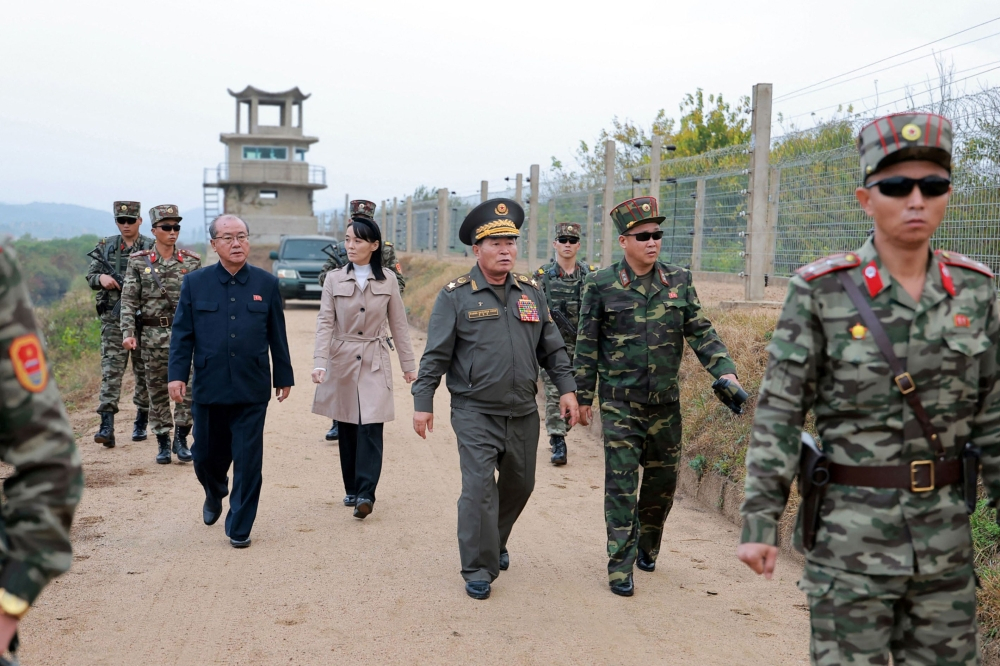
North Korea has announced plans to place new “counter measures” on alert along its border with South Korea, raising concerns over military tensions on the Korean Peninsula. However, South Korea’s military says it has not observed any signs of newly deployed North Korean weapons so far.
The announcement comes amid growing disagreements between the two countries over military activities inside the Demilitarised Zone (DMZ), the heavily mined buffer area that has separated North and South Korea since the 1953 armistice.
Tensions have increased following an explosion last month that injured three South Korean soldiers inside the DMZ. Seoul has accused Pyongyang of violating the armistice agreement, but North Korea has denied responsibility for the incident and dismissed calls for an apology.
Earlier this week, Pyongyang described the border situation as “grave” and said it was considering deploying additional tactical strike capabilities to the area. The statement raised questions about whether North Korea was preparing to increase its military presence along the sensitive frontier.
On Thursday, Kim Yo Jong, the influential sister of North Korean leader Kim Jong Un, said the country would place loudspeakers on standby along the border within days. She also announced that unspecified new “counter means” had been placed on alert, although details about the equipment or capabilities involved were not disclosed.
Her remarks followed an earlier announcement that North Korea had moved additional troop units into firing positions after a visit to the border. These developments have added to concerns about the possibility of further military escalation between the neighbouring countries.
Both North and South Korea have previously used loudspeakers to broadcast propaganda across the border as part of psychological warfare campaigns. Such broadcasts have periodically become a source of friction, with each side accusing the other of provoking tensions.
Despite Pyongyang’s latest statements, South Korea’s military reported no evidence of new North Korean weapons being deployed. Jang Do-young, spokesperson for Seoul’s Joint Chiefs of Staff, told reporters that the military had not observed signs of new types of weaponry being introduced along the border. He added that South Korean forces were continuing to monitor the situation closely.
Regarding North Korea’s announcement about its loudspeakers, Jang said South Korean authorities had already observed routine maintenance activities before Pyongyang released its latest statements. He also suggested that North Korea’s recent public accusations could indicate that South Korea’s ongoing efforts to clear landmines inside the DMZ were having an impact.
North Korea has separately accused South Korean forces of conducting nearly 1,000 provocative loudspeaker broadcasts and firing numerous warning shots between October 1 and 17. Seoul rejected Pyongyang’s account of the situation, arguing that North Korea was attempting to shift responsibility for rising military tensions. South Korea maintained that its loudspeaker broadcasts and warning shots were legitimate defensive measures.
Meanwhile, South Korean President Lee Jae Myung has called on North Korea to return to dialogue, signalling his willingness to pursue communication despite the deteriorating relationship. Kim Yo Jong, however, dismissed the proposal, highlighting the significant gap between the two governments’ positions.
Beyond the current border dispute, North Korea has also recently conducted a series of weapons tests. These reportedly included a new precision-guided torpedo system and an intermediate-range hypersonic missile, with North Korean officials claiming that both systems incorporated artificial intelligence technology.
The latest developments underline how fragile relations remain between the two Koreas. Although South Korea has reported no evidence of newly deployed weapons, North Korea’s warnings, troop movements and plans involving border loudspeakers continue to draw attention to the risks of further confrontation.
For people watching the region, the key question is whether these announcements will remain part of the ongoing exchange of military warnings or lead to more concrete action along the border. With communication between the two governments still strained, careful monitoring and renewed dialogue will be important in preventing tensions from escalating into a more dangerous situation.
Source: AFP. This article has been rewritten for clarity, readability and a more human-centred news presentation.