
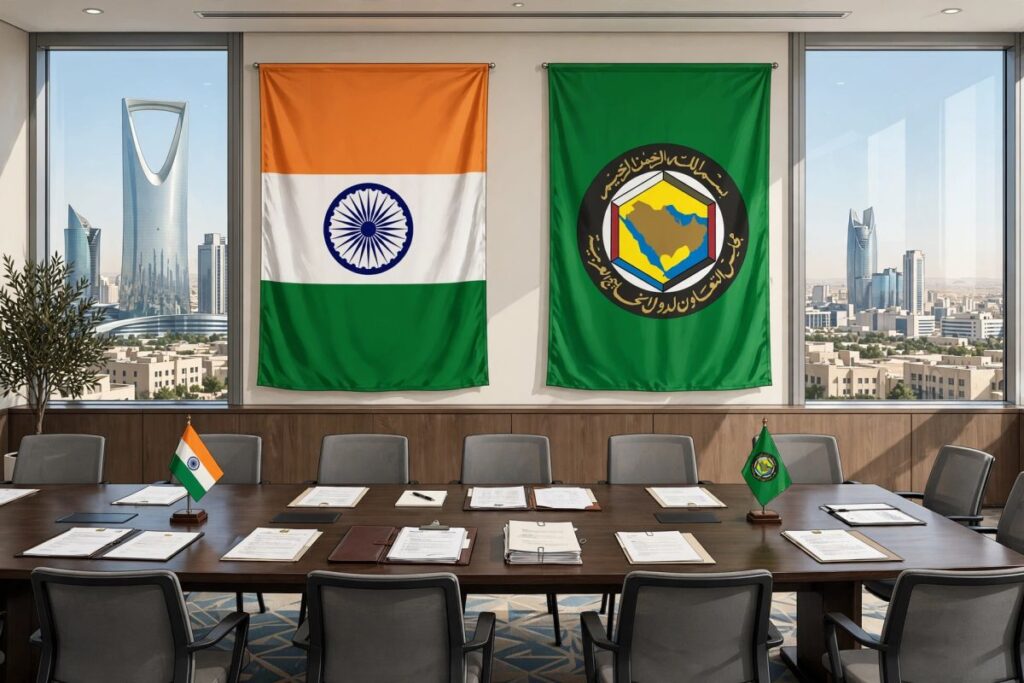
India and the Gulf Cooperation Council are taking another important step toward deepening their economic relationship, with both sides reviewing progress on a proposed free trade agreement and discussing ways to expand cooperation.
The latest discussions took place in Riyadh, where India’s Ambassador to Saudi Arabia, Vipul, met GCC Secretary General Jasem Mohamed Albudaiwi. The two sides discussed the ongoing India-GCC relationship, regional and global developments, and preparations for a ministerial meeting expected next month.
The meeting comes at a significant time for India and the six-member Gulf bloc. Negotiations for a comprehensive free trade agreement resumed in February, with both sides looking to create stronger opportunities for trade and investment. The talks had faced a temporary setback in June amid the wider West Asia crisis.
The GCC brings together Bahrain, Kuwait, Oman, Qatar, Saudi Arabia and the United Arab Emirates. Established in 1981, the bloc has grown into an important political, economic and security partner for countries across the region, including India.
During the Riyadh meeting, India and the GCC also highlighted the importance of continued communication and coordination on shared interests, particularly issues connected to regional security, stability and economic cooperation.
India’s Embassy in Riyadh said the discussions covered India-GCC cooperation, the free trade agreement negotiations and the importance of strengthening high-level engagement between both sides.
The economic relationship is already substantial. The GCC remains India’s largest trading partner bloc, with bilateral trade reaching approximately USD 178.56 billion during 2024-25. This represented around 15.42 percent of India’s total global trade.
India exported goods worth approximately USD 56.87 billion to GCC countries during the period, while imports stood at around USD 121.68 billion.
The trade relationship covers a wide range of sectors. India’s major exports to the Gulf include engineering products, rice, textiles, machinery, gems and jewellery. On the other side, India imports significant quantities of crude oil, LNG, petrochemicals and gold from the region.
Investment is another major pillar of the relationship. GCC countries have become important investors in India, with cumulative investments exceeding USD 31.14 billion as of September 2025.
Beyond trade figures and investment statistics, the India-GCC relationship has a deeply human dimension.
Nearly 10 million members of the Indian community live across GCC countries, making the Gulf one of the most important destinations for Indian workers, professionals, entrepreneurs and families. Their contributions connect businesses, communities and economies on both sides.
The latest round of negotiations also revives a process that began nearly two decades ago. India and the GCC previously held discussions on a free trade agreement in 2006 and 2008 before the bloc deferred negotiations involving free trade agreements with countries and economic groupings.
Since then, India has continued strengthening its economic partnerships in the Gulf. It has already implemented a trade agreement with the United Arab Emirates and signed a Comprehensive Economic Partnership Agreement with Oman.
For businesses, exporters, investors and communities, the renewed India-GCC negotiations could represent more than another diplomatic milestone. A successful agreement could potentially create new avenues for market access, investment, supply-chain cooperation and cross-border business.
The Gulf is already closely connected to India through trade, energy, investment and the Indian diaspora. A stronger trade framework could take that relationship into a new phase.
Ultimately, behind every trade agreement are people and businesses looking for opportunities. An easier path for goods, services, investment and collaboration could mean new possibilities for entrepreneurs, exporters, investors and professionals across India and the Gulf.
As negotiations move forward, businesses on both sides will be watching closely. The next stage could determine how much further India-GCC economic cooperation can grow in the years ahead.