
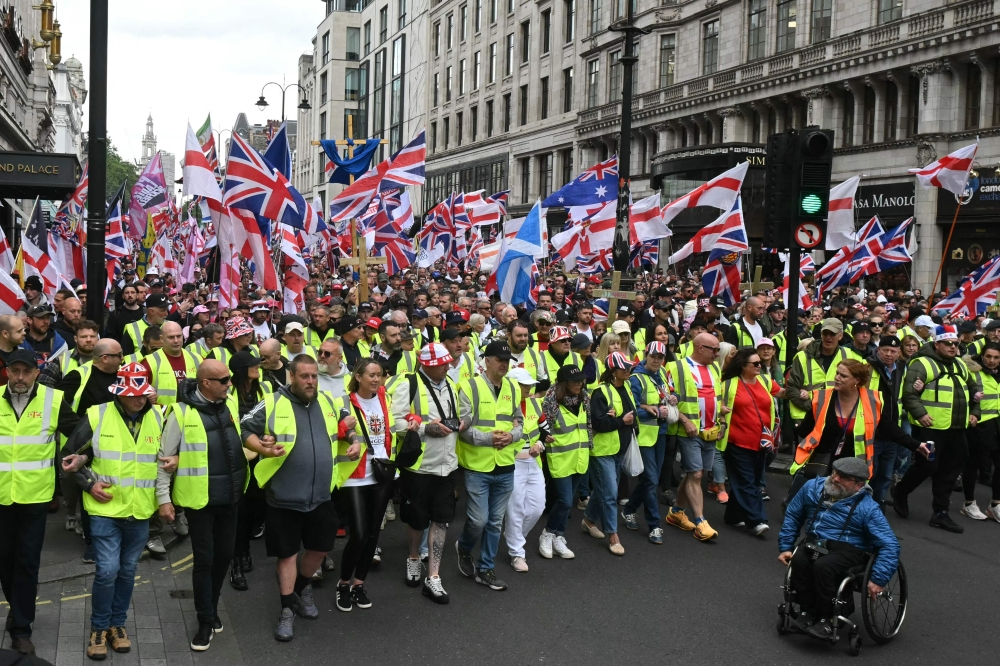
Thousands of demonstrators filled the streets of London on Saturday as rival protests unfolded across the city, creating one of the largest politically charged public gatherings seen in recent months. The march organised by far-right activist Tommy Robinson drew tens of thousands of supporters, while counter-protesters joined anti-racism and pro-Palestinian groups in a separate demonstration nearby.
London’s Metropolitan Police launched a major security operation involving around 4,000 officers, along with mounted police, drones, helicopters, and police dogs, to prevent clashes between opposing groups and maintain order during the tense day of protests.
The “Unite the Kingdom” rally began in Holborn before crowds marched toward Parliament Square, where Robinson and several speakers addressed supporters. Many attendees waved British and English flags, wore red “Make England Great Again” caps, and voiced frustration over immigration policies, national identity, and concerns surrounding public safety.
Several supporters at the rally claimed illegal immigration and border security were among their biggest concerns. Others stated they were attending to defend what they described as traditional British values and freedom of speech.
At the same time, another large gathering took place in west London to mark Nakba Day, commemorating the displacement of Palestinians during the creation of Israel in 1948. The demonstration merged with an anti-fascism protest organised by Stand Up to Racism, with participants expressing fears over growing racism, extremism, and division in Britain and across Europe.
Police later confirmed dozens of arrests linked to the protests and additional incidents surrounding the FA Cup Final held at Wembley Stadium the same day. Authorities also reported assaults on police officers and hate-related offences during the demonstrations.
Tommy Robinson, whose real name is Stephen Yaxley-Lennon, has become one of Britain’s most controversial far-right figures. Known for his anti-Islam activism, his online following and public influence have significantly increased in recent years. His previous rally in London last September also drew huge crowds and sparked national debate over extremism, immigration, and political tensions in the UK.
Ahead of Saturday’s demonstrations, Prime Minister Keir Starmer warned that authorities would act firmly against violence, intimidation, and hate speech. The government also reportedly blocked several foreign far-right figures from entering the country before the rally.
The protests come during a period of heightened tension in Britain, with growing concerns over antisemitism, Islamophobia, political extremism, and national security. The UK recently raised its terrorism threat level to “severe,” citing risks connected to both Islamist and far-right extremism.
The events in London once again highlighted the deep political and social divisions currently shaping public debate in the United Kingdom. While some participants claimed they were fighting for national identity and security, others warned that rising extremism and hate-driven politics could further divide communities and fuel instability across Europe.
As political tensions continue to rise globally, Saturday’s demonstrations showed how issues like immigration, nationalism, racism, free speech, and international conflicts are increasingly colliding on the streets of major cities. Many observers believe the coming years could see even larger public confrontations as societies struggle to balance security, identity, freedom, and social unity in an increasingly polarised world.